Your Brand Updated Its Standards. Your Live Projects Never Found Out.
November 19, 2026

In February, a lounge chair fabric at one of the brand's resorts started pilling eleven months after opening. By March, the brand standards team had done everything right. They traced the failure, raised the guestroom upholstery minimum from 30,000 to 50,000 double rubs, issued revision 7 of the FF&E standards book, and emailed the PDF to the distribution list.
Two states away, a 240-key PIP was already in procurement. Its spec book had been checked against revision 6 in January. The same fabric was on the purchase order, the acknowledgment had come back, and the mill was cutting. Nobody on that project was on the distribution list, and nobody on the distribution list knew that project used the fabric.
Eighteen months later the chairs at that property pill too. Nobody did anything wrong. The standard simply never reached the project.
That is the quiet failure in hotel brand standards compliance. Compliance is usually checked once, at submittal review, against whatever revision was current that week. After that, the standard keeps moving and the project doesn't. The fix is not a better PDF. It's deciding, in advance, which live projects a change should reach and who carries it there.
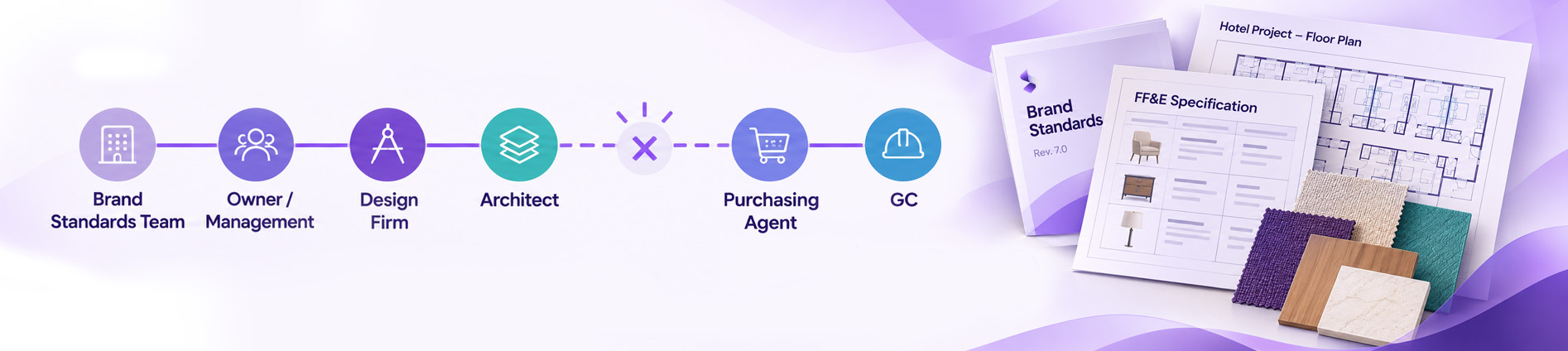
Because the people who write the standard and the people who build to it rarely touch the same document twice.
On a branded hotel project, up to four parties hold a piece of the FF&E brand standards: the brand standards team, the owner or management company, an outside interior design firm, and often an architect who specifies some of the FF&E too. Add the purchasing agent and the GC and the chain gets longer. The brand standards team writes and maintains the standard, hands it over at project kickoff, and then, in most organizations, has no day-to-day contact with the project at all.
The handoff is usually a PDF. Plans live in AutoCAD, the preferred supplier list lives in Excel, and the spec book lives with the design firm. So a revision has no address. It goes to a distribution list, not to the 14 projects that specified the item.
The update cycle makes it worse. Brands revise their standards anywhere from twice a year to every three to five years, and revisions tend to arrive for reasons nobody planned: a fabric that fails in the field, a supplier that discontinues a finish, a code change, a palette refresh. New projects get the newest revision by default. Running projects are rarely reopened, because, as one brand-side expert put it, "time is seriously money."
There's a reasonable instinct behind that. Reopening an approved spec book costs the design firm fees, the purchasing agent a requote, and the owner weeks. But "rarely reopened" quietly becomes "never checked," and that's where compliance breaks.

More than the standard was supposed to save. Three failure modes show up again and again.
The failure repeats at scale. A brand changes a standard because something broke. If a live project never hears about it, the property installs the exact thing that broke, in every key. Take the chair above as a worked example: 240 rooms, one lounge chair each. If reupholstery runs $400 a chair, the brand's fix arrives as a $96,000 bill at a property that was built after the fix existed. It's the model room argument in reverse. One bad chair is a note; 240 is a recall.
The discontinued item surfaces at acknowledgment. A supplier drops a finish. The brand swaps in an approved alternate and relays it through drawings and schedules, by hand. The project that didn't get the memo issues its PO, typically with a 50% deposit on custom work, and the acknowledgment comes back with a substitution or a new lead time. Now the purchasing agent is sourcing an alternate under production pressure, and the design firm is re-specifying an item the brand had already re-specified months earlier.
Compliance is approved against the wrong revision. The owner's HQ reviews a resubmitted spec book against the standard it has on file. If two reviewers hold different revisions, the same item passes on one project and fails on the next. That's how life-safety details slip: drapery specified to NFPA 101 when the brand requires NFPA 701 looks fine to anyone not reading the current clause.
None of these show up as a line item called "standards gap." They show up as change orders, reupholstery, a late room block, or a franchise inspection finding during the next PIP.
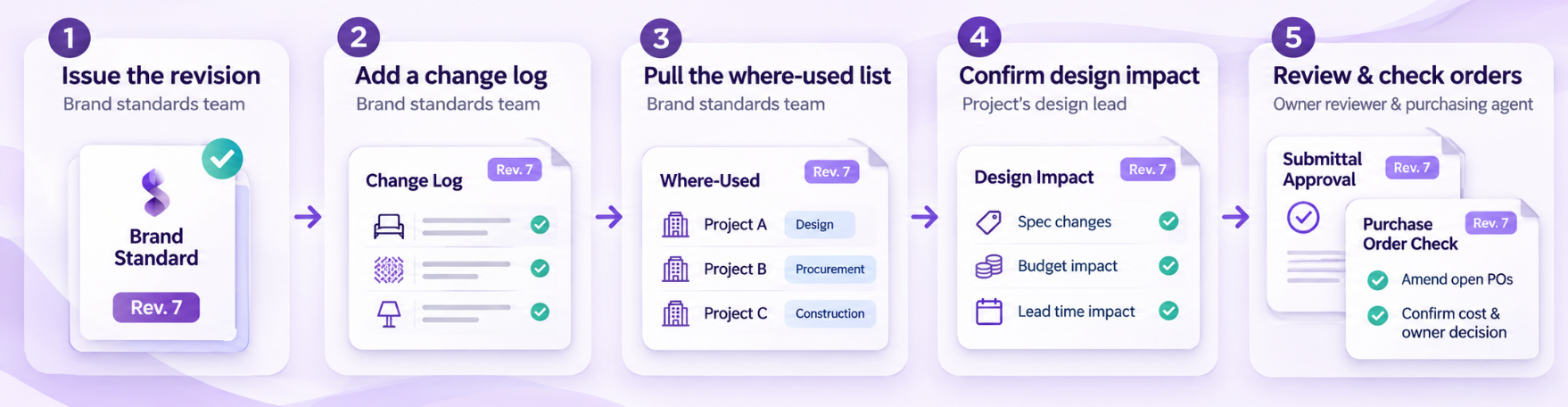
Not one person. A revision crosses five desks, and each one needs a name on it before the revision goes out, not after.
The document that holds it together is small: a revision number on every spec book, every submittal approval, and every PO. When the next PIP inspector asks why a property has the old fabric, the answer is on paper instead of in someone's inbox.
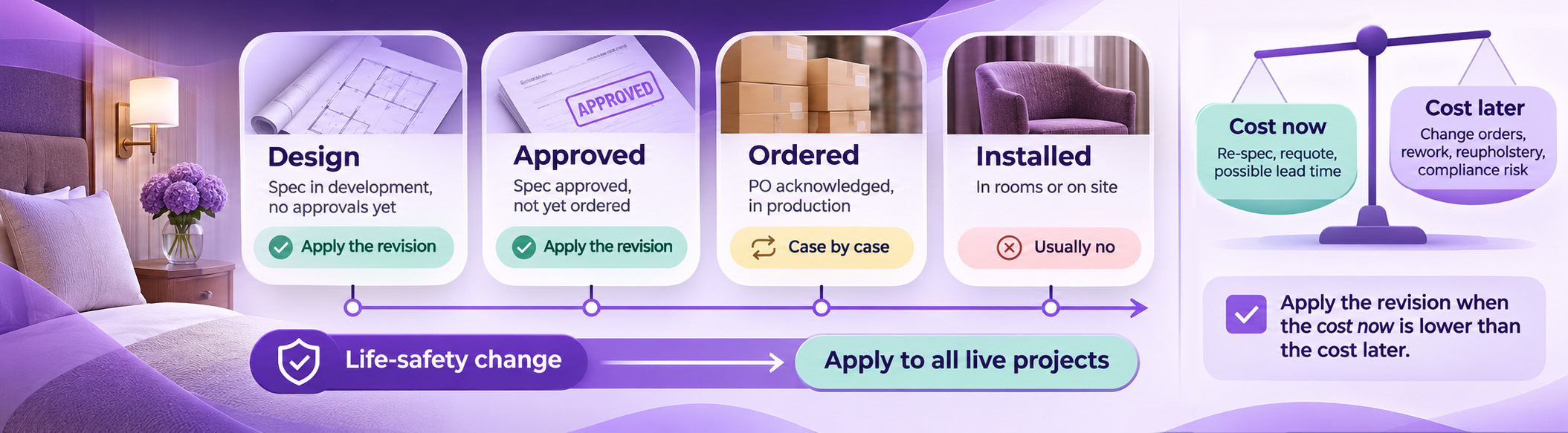
The ones where the change is cheaper now than after install. That depends on two things: why the standard changed, and how far the project has moved.
Most teams argue this case by case, every time. A better approach is to decide it once, in writing, and attach the rule to every revision. Here's a starting version a brand standards team can adapt.
Two things make the table work. First, the brand standards team tags every revision with its trigger, so nobody has to guess which row applies. Second, "ordered" means acknowledged, not just issued: a PO that hasn't been acknowledged is still a document, and it can still change.
The tension here is real. Brand standards exist to protect the guest experience; owners carry the cost of every reopened spec. A written rule doesn't remove that tension. It moves the argument from the week a PO goes out to the day the revision is issued, when it's cheaper to have.
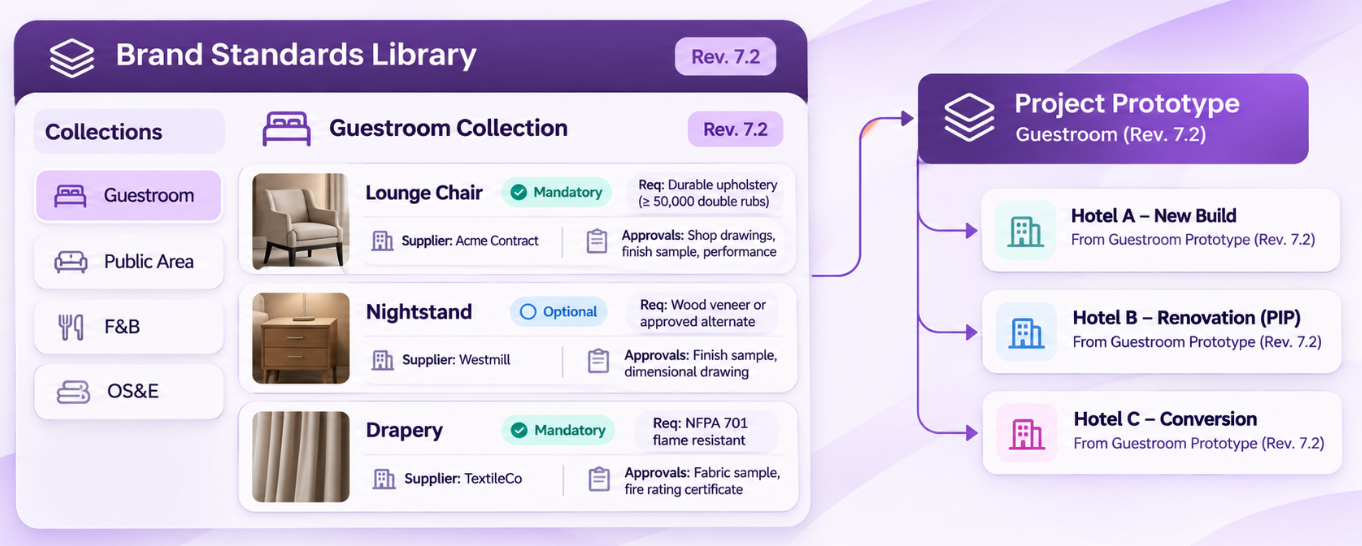
Structure, not storage. A shared drive can hold every revision of the PDF. It can't tell you which projects specified the fabric in revision 6.
Three properties separate a library you can enforce from one you can only archive. Each standard is written as a requirement, not just a SKU ("non-porous natural stone, not slippery"), so a designer can re-specify with judgment when the reference product disappears. Each item is marked mandatory or optional, so the brand's essence is locked and the designer keeps latitude where the brand allows it. And each item carries its own instructions and approval requirements (shop drawings, finish samples, fire ratings) into the project, instead of leaving them on page 84 of a PDF.
That's the structure SpeCurate is built around. Brand standards teams set up Collections per brand, region, tier or space: each item flagged mandatory or for design review, with its suppliers, instructions and requirements attached, so they travel with the item when a designer adds it to a project. Project prototypes give each new property a starting point built from the current standard rather than from the last job's spec book.
The same drift shows up outside hotels. In restaurant rollouts it starts around location 31, when each new store copies the last one instead of the standard.
If you can't fill in the fourth line, you're not alone, and that's the conversation worth having. See how brand standards teams set up Collections in SpeCurate by Fohlio, or book a demo and bring your current standards book.
Owners asking what their design partners' AI can and can't check against a standard can join our free 30-minute webinar on December 8, The AI Handoff: What Owners Should Expect From Their Design Partners.
What is hotel brand standards compliance? It's proof that a property's FF&E, OS&E and finishes meet the brand's current requirements for design, durability, safety and operations. On renovations and new builds it's usually checked at submittal review, when the owner or brand reviews the design firm's spec book against the standard.
How often do hotel brands update their FF&E brand standards? It varies widely, from twice a year to every three to five years. Many revisions are unplanned, triggered by a product failing in the field, a supplier discontinuing an item, a code change, or a design refresh.
Do projects already underway have to adopt a new standards revision? Usually not automatically. New projects get the current revision, and running projects are rarely reopened. Whether a specific change applies should depend on why it changed and how far the project has moved; life-safety changes are the clearest case for applying it everywhere. Check your franchise or management agreement for what's required.
What's the difference between FF&E and OS&E brand standards? FF&E standards cover furniture, fixtures and equipment such as case goods, seating, lighting and millwork, usually funded from capital or PIP budgets. OS&E standards cover operating supplies such as linens, tableware and amenities, set for pre-opening and replenished from operating spend.
Who is responsible for brand standards compliance on a PIP? The owner is accountable to the brand, but the work is shared: the brand standards team writes the standard, the design firm specifies to it, the owner's or brand's reviewer approves submittals, and the purchasing agent buys what was approved. Compliance breaks where a change has no named owner between those steps.
What is submittal review in hospitality? The step where an outside design firm submits its spec book to the owner or brand, which checks each item against the brand standards before procurement starts. Missing fields like yardage and quantities are a common reason for resubmission.